How to Choose an iPhone Aftermarket Screen
The global market for iPhone aftermarket screens has evolved significantly over the past few years. Today’s replacement screens offer a wider range of display technologies, quality levels, and price points than ever before. While this gives distributors and repair businesses greater flexibility, it also makes product selection more challenging.
An LCD screen may be the most economical choice, while Hard OLED offers a balance between performance and cost. Soft OLED delivers an experience closer to the original display, and newer innovations such as diagnostic-compatible screens and 120Hz high refresh rate screens are redefining expectations for premium aftermarket products.
Understanding the differences between these screen types is essential for choosing the right solution based on performance requirements, market positioning, and procurement budget.
iPhone Aftermarket Screen Explained
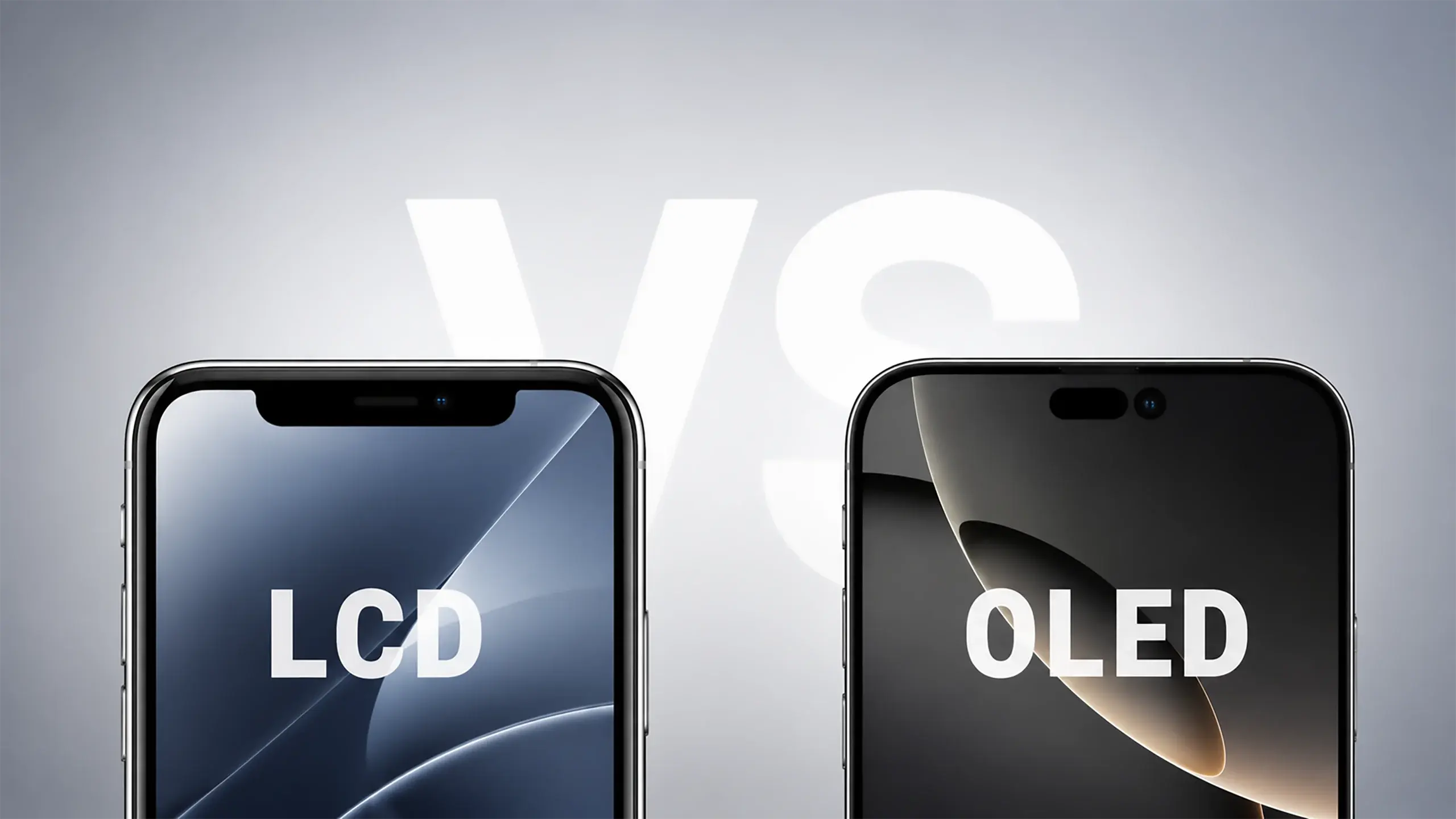
Based on display technology, common iPhone aftermarket screen assembly can be divided into OLED and LCD.
LCD Screen
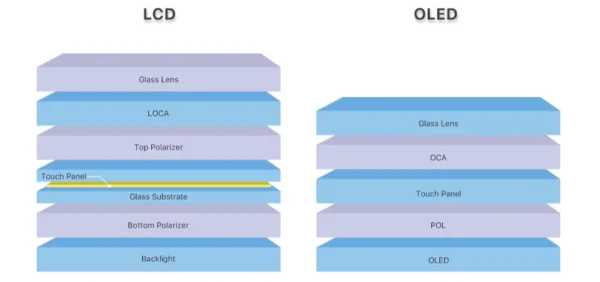
LCD screens use a traditional liquid crystal display structure combined with integrated touch technology.
Unlike OLED panels, LCD pixels cannot produce their own light. Instead, they require a separate backlight module behind the LCD layer to illuminate the image.
A typical Incell display structure includes:
- Backlight module
- Polarizer
- Liquid crystal layer
- Color filter layer
- Touch sensor layer integrated into the LCD panel
- Cover glass
The Incell technology integrates the touch layer directly into the display panel, reducing the number of separate layers compared with traditional LCD assemblies.
Key Structural Characteristics
Backlight-Based Display
Because LCD pixels cannot emit light independently, the entire display requires a backlight source. This allows LCD screens to produce consistent brightness but limits their ability to display true black.
When displaying black images, the backlight remains active, causing black areas to appear slightly gray compared with OLED technology.
Integrated Touch Layer
Incell technology combines touch sensing with the LCD panel, making the display assembly thinner than older LCD designs while maintaining reliable touch performance.
More Layered Display Structure
Compared with OLED, LCD requires additional optical components, including the backlight and liquid crystal layers. This creates a different display structure and affects thickness, contrast performance, and power efficiency.
OLED Screen
Unlike LCD, OLED (Organic Light-Emitting Diode) technology does not require a backlight.
Each OLED pixel contains self-emissive components that generate its own light. When a pixel needs to display black, it can simply turn off completely, creating true black and higher contrast.
The basic OLED structure includes:
- Cover glass
- Polarizer
- OLED emission layer
- Thin-film transistor (TFT) layer
- Flexible or rigid substrate
OLED technology can be further classified into Soft OLED and Hard OLED based on their substrate structure. Soft OLED adopts a flexible substrate that allows the panel to withstand bending stress and external impact more effectively. As a result, it provides enhanced durability and repairability compared with Hard OLED, while requiring more advanced manufacturing processes and higher production costs.
Incell vs Oncell vs Outcell
Screen assemblies can be also classified into Incell, Oncell, and Outcell depending on how the touch panel is integrated into the display structure. The key distinction between these solutions is the location of the touch sensor layer.
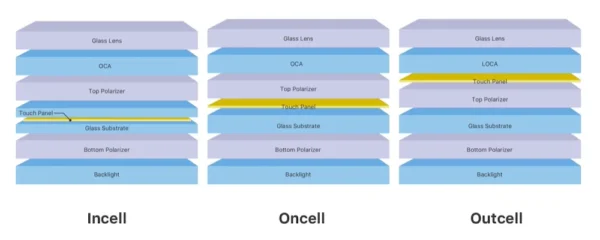
With Incell technology, the touch layer is embedded inside the display glass substrate. Oncell technology places the touch layer on top of the glass substrate but below the polarizer, while Outcell technology separates the touch panel and positions it above the polarizer and beneath the cover glass.
Among these three structures, Incell offers the most integrated design, resulting in superior stability and faster touch response, while Oncell and Outcell provide different levels of performance based on their structural designs.
Test and Comparison of Different iPhone Aftermarket Screens
While specifications provide a general understanding of different display technologies, real performance is what truly distinguishes one screen from another. Factors such as brightness, color accuracy, viewing angles, structural design, and touch responsiveness all contribute to the overall user experience and long-term reliability.
The following comparisons highlight the key differences between LCD, Hard OLED, and Soft OLED using common performance indicators that matter in everyday repairs.
Brightness Performance
Brightness directly affects outdoor visibility and overall display quality. Modern Incell screens have improved significantly and provide sufficient brightness for most daily applications. Hard OLED offers higher peak brightness and better uniformity, while Soft OLED delivers the most consistent brightness across the entire display, closely matching the original iPhone screen.
Color Reproduction
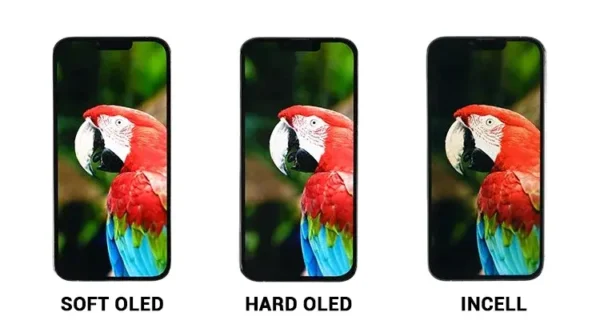
OLED technology allows each pixel to emit its own light, producing richer colors and significantly higher contrast than LCD. Soft OLED provides the closest color accuracy to the original display, while Hard OLED delivers excellent color performance at a more competitive price. Incell screens remain suitable for standard repairs but generally display slightly less vibrant colors.
Black Level and Contrast
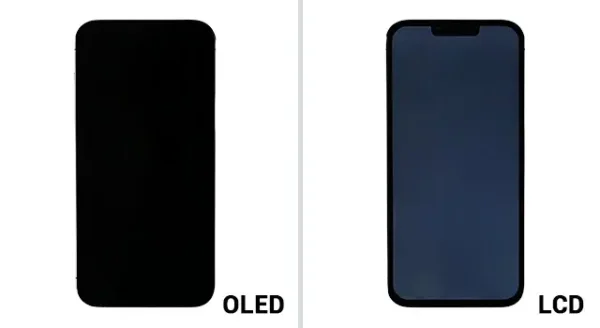
One of the biggest visual differences between LCD and OLED is black reproduction. LCD panels rely on a backlight, so black areas often appear dark gray. OLED screens can completely turn off individual pixels, producing true blacks and much higher contrast.
New Trends in iPhone Aftermarket Screens
The aftermarket display industry continues to evolve as Apple introduces new repair technologies and higher display standards.
Diagnostic-Compatible Screens
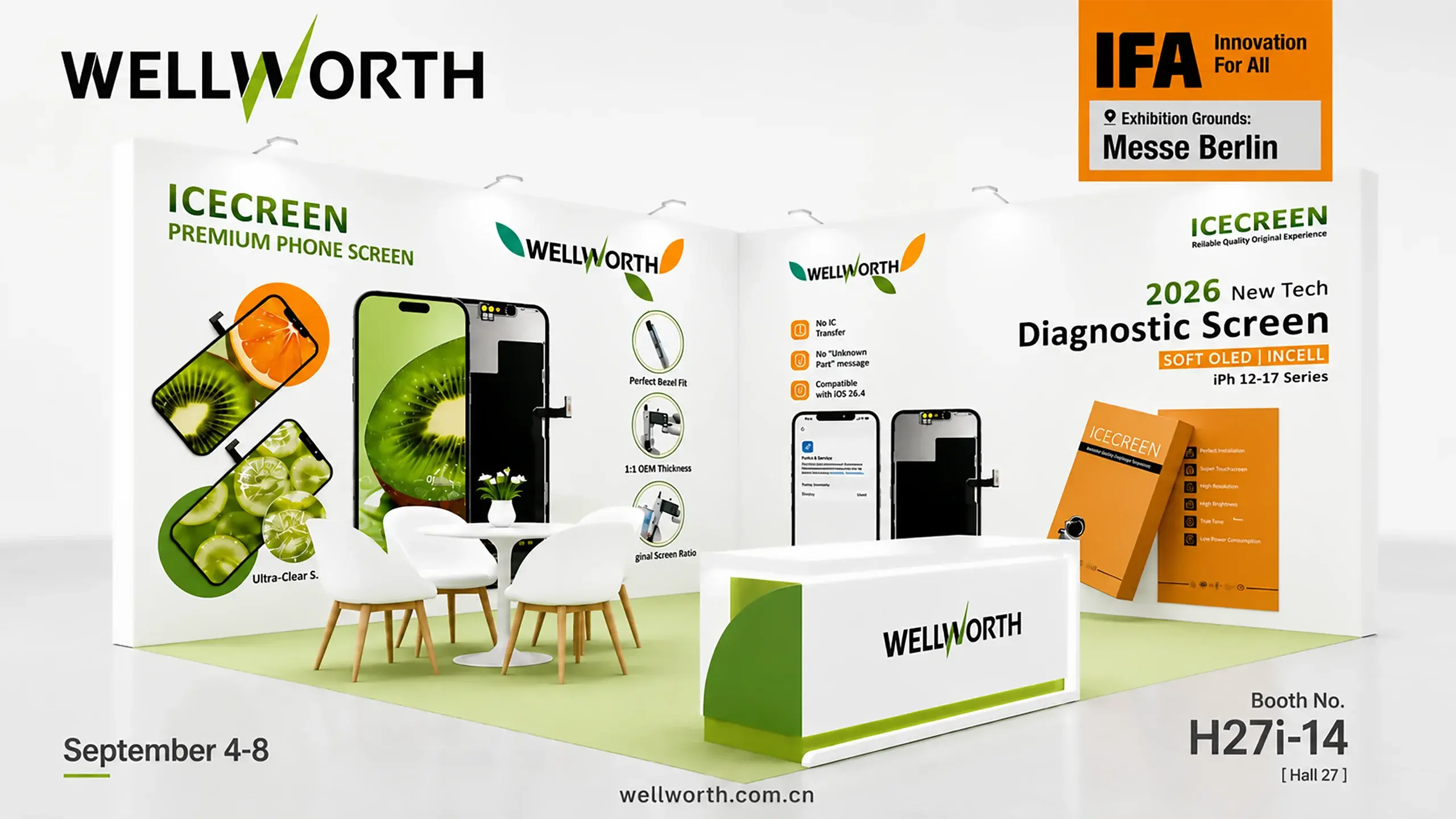
One of the most significant developments is the introduction of Diagnostic-Compatible Screens.
Unlike conventional aftermarket displays, these screens simplify installation and improve compatibility with Apple’s latest repair ecosystem.
Key advantages include:
- No IC transfer required
- No True Tone programming required
- Supports iOS Diagnostics and Repair Assistant workflows
- Part status may display as “Used” instead of “Unknown Part”
- Faster installation with fewer repair steps
As Apple’s repair processes become increasingly software-driven, Diagnostic-Compatible Screens are expected to become an important category in the aftermarket industry.
120Hz High Refresh Rate Screens
120Hz High refresh rate displays are also becoming an emerging trend in the aftermarket market.
Traditionally, most replacement screens supported only 60Hz refresh rates. However, newer aftermarket solutions are beginning to support 120Hz ProMotion-like performance for compatible iPhone models.
Compared with standard displays, 120Hz screens provide:
- Smoother scrolling
- More responsive touch interaction
- Improved gaming performance
- Better visual fluidity
- A user experience closer to the original display
As demand for premium replacement parts continues to grow, high refresh rate aftermarket screens are expected to play an increasingly important role in the future.
Conclusion
Choosing the right iPhone aftermarket screen involves much more than comparing prices. LCD, Hard OLED, and Soft OLED each offer distinct advantages for different applications, while new innovations such as Diagnostic-Compatible Screens and 120Hz High Refresh Rate Screens continue to raise the standard for aftermarket replacement displays.
By understanding the strengths and limitations of each screen type, businesses can build a product portfolio that balances cost, performance, and long-term reliability—helping meet diverse market demands while staying competitive in the rapidly evolving iPhone repair industry.